


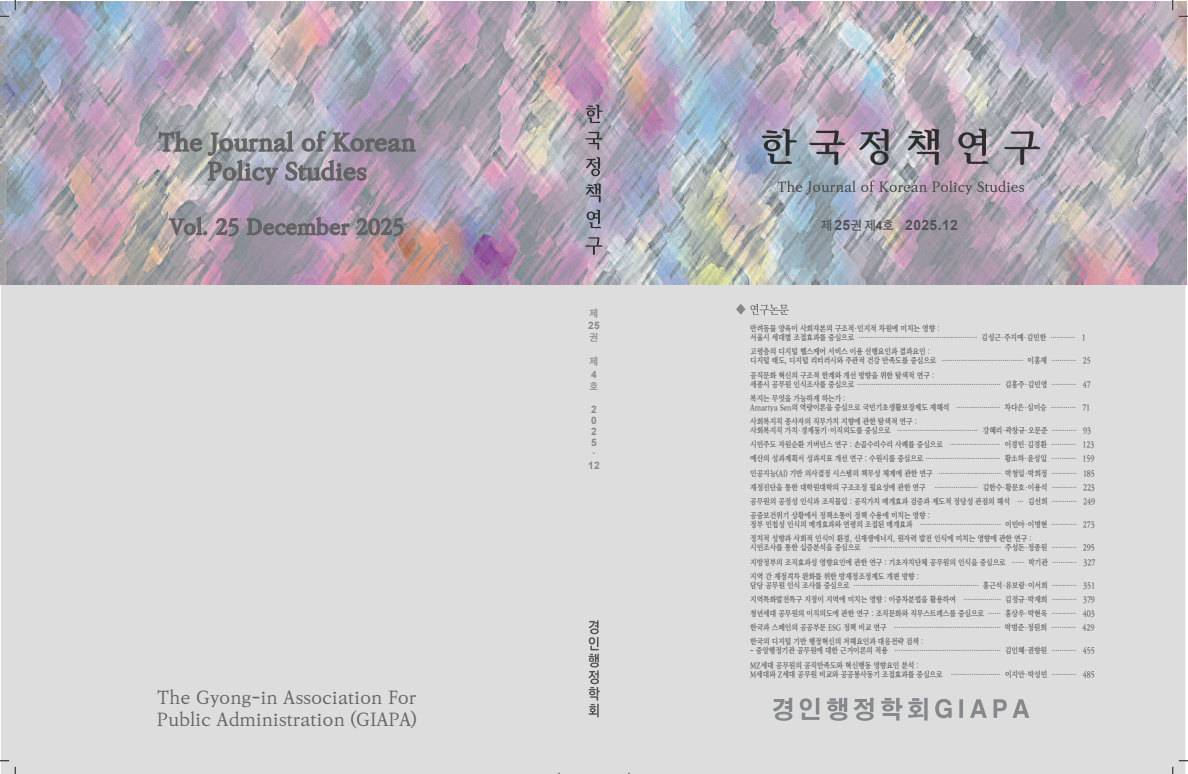
 경인행정학회
정치적 성향과 사회적 인식이 환경, 신재생에너지, 원자력 발전 인식에 미치는 영향에 관한 연구: 시민조사를 통한 실증분석을 중심으로
The Impact of Political Ideology and Social Perception on Attitudes toward the Environment, Renewable Energy, and Nuclear Power: An Empirical Analysis Based on a Public Survey
- 창간연도
- 2002년 2월
- ISSN
- (Print)1598-7817 , (Online)2713-6744
- 등재사항
- KCI등재(2019.01 ~ 현재)
- 수록권호
- 제25권 4호
- 발행일
- 2025.12
- 수록논문
- 19 articles
- 유형
- 학술저널
- 주제
- 사회과학
- 발행기간
- 2002.02 ~ 2025.12
- 발행주기
- 연 4회(계간)
- 총 권호 수
- 78 volumes
- 총 논문 수
- 771 articles
키워드
초록
본 연구는 정치적 성향과 사회적 정향이 원자력 에너지 및 환경정책 인식에 미치는 영향을 통합적으로 분석하는 것을 목적으로 한다. 한국의 원전 정책은 정권교체에 따라 급격한 정책 전환을 반복해 왔으며, 이는 시민들의 정책 신뢰를 약화시키고, 정치 이념·사회적 정체성에 따른 인식의 양극화를 심화시켜 왔다. 이러한 문제의식을 바탕으로, 정치적 성향과 주관적 소득 인식이 원자력 발전, 신재생에너지, 기후·환경 정책, 그리고 환경에 대한 태도 및 행태에 어떠한 영향을 미치는지 실증적으로 규명하고자 한다.분석 결과, 보수 성향의 시민은 원자력 발전에 대해 상대적으로 긍정적인 정책 태도를 보인 반면, 진보 성향의 시민은 부정적인 태도를 보이는 것으로 나타났다. 반면, 주관적 소득 인식은 원자력과 신재생에너지, 환경 관련 인식 전반에 대해 통계적으로 유의미한 영향을 미치지 않는 것으로 분석되었다. 또한 정부에 대한 신뢰 수준이 높을수록 원전 정책과 기후정책의 효과성에 대해 긍정적으로 평가하는 경향이 확인되었다. 이러한 연구 결과는 원자력 발전, 신재생에너지, 기후·환경 정책의 설계와 집행 과정에서 시민의 정치적 성향, 신뢰 수준, 사회심리적 특성, 그리고 집단적 맥락을 정밀하게 고려할 필요가 있음을 시사한다. 나아가, 단순한 정보 제공 중심의 접근을 넘어, 신뢰에 기반한 정책 커뮤니케이션과 시민 참여 전략을 강화하는 것이 정책 수용성과 효과성을 높이는 핵심적 과제이다.
This study examines how citizens’ political ideology, subjective income perception, trust in government, and trust in science shape their views on nuclear energy, renewable energy, and environmental and climate policies in South Korea. The findings show that conservatives hold more favorable attitudes toward nuclear power, whereas progressives are more negative, while subjective income perception has no significant effect on energy- and environment-related perceptions. Higher trust in government is associated with more positive evaluations of nuclear and climate policy effectiveness. These results highlight the need for policy design and implementation that account for citizens’ socio-psychological characteristics and for trust-based policy communication to enhance public acceptance.
목차
Ⅰ. 서론Ⅱ. 이론적 배경 및 선행연구 검토
Ⅲ. 연구모형 및 연구방법
Ⅳ. 분석결과
Ⅴ. 결론 및 함의
참고문헌 (48)
- 김근식·김서용.(2017). 원자력 에너지의 위험 통신과 신뢰에 관한 연구. 『한국정책학회보』, 33(3), 73-94.
- 김승현·박명진.(2025). 한국의 정당한 절차와 절차를 밟아야 합니다. 『정책과학연구』, 42(1), 55-78.
- 김승현·이재우.(2023). 정책 변동성에 따른 원자력 정보신뢰도 영향 연구. 한국정책학회보, 45(2), 123-145.
- 김효정.(2017). 위험 이슈에 대한 정파적 정보처리와 태도양극화: 원자력 발전 이슈를 중심으로. 『한국언론학보』, 61(6), 7-39.
- 박규희·양준석.(2023). 환경 문제에 대한 인식과 원자력 에너지에 대한 태도. 『환경정책』, 31(2), 145-172.
- 박희철.(2024). 원자력법과 지역경제의 이해관계. 『에너지정책연구』, 39(1). 67-82.
- 이형민․이진균.(2021). 사회적인 가치, 사법적 신호, 국회가 원자력 관리 기관 신뢰도, 원자력 발전 기술 수신, 처리원자력에 따라 반응에 관한 연구. 『홍보연구』, 25(2), 102-127.
- 장하영.(2019). 정치적 성향이 원자력 발전 수용성에 대해 미치는 영향. 『한국정책학회보』, 28(3), 295-319.
- 장하영·김주경.(2017). 우리나라 국민들의 원자력발전 수용성에 미치는 영향요인 분석. 『한국행정논집』, 29(2), 361-384.
- 주성돈.(2011). 원자력정책의 변동에 관한 연구, 가톨릭대학교 박사학위논문.
- 최경민.(2022). 전력 에너지에 대한 심사 분석. 『사회과학연구』, 34(4), 211-230.
- 홍채영 외.(2024). 원자력 에너지에 대한 인식 차이 분석: LDA와 BERTopic을 활용한 전문가와 대중 비교. 『정보화정책』, 31(1), 3-22.
- Besley, J. C., & Oh, S. H.(2014). The impact of accident attention, ideology, and environmentalism on American attitudes toward nuclear energy. Risk Analysis, 34(5), 949-964.
- gyekum, E. B., et al.(2025). A systematic review of nuclear energy and public perception: Understanding global attitudes. Energy Reports, 11, 1234-1256.
- Alhakami, A., & Slovic, P.(1994). A psychological study of the inverse relationship between perceived risk and perceived benefit. Risk Analysis, 14(6), 1085-1096.
- Caplan, B.(2007). The Myth of the Rational Voter: Why Democracies Choose Bad Policies. Princeton University Press.
- _________.(2011). Rational irrationality and the microfoundations of political failure. European Journal of Political Economy, 27(1), S134-S146.
- Cruwys, T., Stevens, M., & Greenaway, K.(2021). A social identity perspective on COVID-19. Group Processes & Intergroup Relations, 24(2), 276-287.
- Douglas, M., & Wildavsky, A.(1982). Risk and Culture: An Essay on the Selection of Technical and Environmental Dangers. University of California Press
- Downs, A.(1957). An Economic Theory of Democracy. Harper and Row.
- Emilsson, V., Gudnason, V. & Jennings, L. L.(2019). Predicting health and life span with the deep plasma proteome. Nat. Med. 25, 1815?1816.
- Energe, S., et al.(2021). The paradoxical effect of trust in government on public acceptance of nuclear energy: Evidence from South Korea. Energy Policy, 151, 112183.
- Finucane, M., Alhakami, A., Slovic, P., & Johnson, S.(2000). The affect heuristic in judgments of risks and benefits. Journal of Behavioral Decision Making, 13(1), 1-17.
- Ghazali, E. M., Nguyen, B., Mutum, D. S., & Mohd-Any, A. A.(2019). Pro-environmental behaviours and value-belief-norm theory: Assessing unobserved heterogeneity of two ethnic groups. Sustainability, 11(12), 3237.
- Gallup.(2018). Wellcome Global Monitor: How Does the World Feel about Science and Health? Wellcome Turst Report.
- Gregersen, H., Røine, A., & Roness, P. G.(2020). The social integration of wind energy projects: A case study of political dynamics in a Norwegian municipality. Energy Research & Social Science, 66, 101535.
- ISSP Research Group.(2019). International Social Survey Programme: Environment III - ISSP 2010 (ZA5500; Version 3.0.0) [Data set]. GESIS, Cologne. https://doi.org/10.4232/1.13271
- Kahan, D. M., Braman, D., Gastil, J., Slovic, P., & Mertz, C. K.(2007). "Culture and Identity-Protective Cognition: Explaining the White Male Effect in Risk Perception." Journal of Empirical Legal Studies, 4(3), 465-505.
- Kahan, D. M., Jenkins-Smith, H., & Braman, D.(2011). "Cultural cognition of scientific consensus." Journal of Risk Research, 14(2), 147-174.
- Kahan, D. M.(2012). "Cultural cognition as a conception of the cultural theory of risk." In S. Roeser (Ed.), Handbook of Risk Theory: Epistemology, Decision Theory, Ethics, and Social Implications of Risk(pp. 725-759). Springer.
- McBeth, M. K., Lybecker, D. L., & Husmann, M. A.(2023). Political ideology and nuclear energy: Perception of risk and trust of information sources. Public Opinion Quarterly, 87(S1), 133-158.
- MacKinnon, M. & Davis, A. & Arnocky, S.(2022). Optimistic Environmental Messaging Increases State Optimism and in vivo Pro-environmental Behavior. Frontiers in Psychology. 13, Article 856063.
- OECD-NEA.(2023). The perception of science, risk and nuclear energy: An international survey. OECD Nuclear Energy Agency Working Paper.
- OECD.(2024). OECD Survey on Drivers of Trust in Public Institutions – 2024 Results: Building Trust in a Complex Enviroment. OECD
- Olsen, M. E., Rosa, E. A., & Dunlap, R. E.(1988). Stigma and radioactive waste: Theory, assessment, and some empirical findings from Hanford, WA. In R. G. Post (Ed.), Waste Management, 88(2), 95-102.
- Rothman, S., & Lichter, S. R.(1987). Elite ideology and risk perception in nuclear energy policy. American Political Science Review, 81(2), 383-404.
- Seidl, R., Moser, C., Blumer, Y. B., & Stauffacher, M.(2022). The role of trust and risk perception in current German energy policy debates on high-level radioactive waste repository siting. Risk Analysis, 42(4), 806-824.
- Slovic, P., Fischhoff, B., & Lichtenstein, S.(1982). "Response Mode, Framing, and Information-Processing Effects in Risk Assessment." In New Directions for Methodology of Social and Behavioral Science, 11, 21-36.
- Slovic, P.(1987). Perception of risk. Science, 236(4799), 280-285.
- ________. (1993). Perceived risk, trust, and democracy. Risk Analysis, 13(6), 675-682.
- Stern, P. C., Dietz, T., Abel, T. D., Guagnano, G., & Kalof, L.(1999). A Value-Belief-Norm Theory of Support for Social Movements: The Case of Environmentalism. Human Ecology Review, 6(2), 81-97.
- Tajfel, H.(1974). Social identity and intergroup behaviour. Social Science Information, 13(2), 65-93.
- TNO & NRG PALLAS.(2025). Public trust and nuclear energy: An adaptive policy approach. TNO Report.
- Turner, J. C.(1987). Rediscovering the Social Group: A Self-categorization Theory. Blackwell.
- Tyson, A. & Kennedy, B.(2024). How Americans View Future Harms from Climage Change in Their Communicy and Around the U.S. Pew Research Center.
- Webber. D. J.(1982). Is Nuclear Power Just Another Environmental Issue? An Analysis of California voters. Environment and Behavior, 14, 72.
- Whitfield, S. C., Rosa, E. A., Dan, A., & Dietz, T.(2009). The future of nuclear power: Value orientations and risk perception. Risk Analysis, 29(3), 425-437.
- Xiao, Q., Liu, H., & Feldman, M. W.(2017). How does trust affect acceptance of a nuclear power plant (NPP): A survey among people living with Qinshan NPP in China. PLoS ONE, 12(11), e0187941.
참고문헌 더보기
- 이전논문공중보건위기 상황에서 정책소통이 정책 수용에 미치는 영향 : 정부 민첩성 인식의 매개효과와 연령의 조절된 매개효과 The Effect of Policy Communication on Policy Acceptance in a Public Health Crisis: The Mediating Role of Perceived Government Agility and the Moderated Mediation Effect of Age
- 다음논문지방정부의 조직효과성 영향요인에 관한 연구- 기초자치단체 공무원의 인식을 중심으로 - A Study on the Factors Affecting Organizational Effectiveness of Local Governments