


 경인행정학회
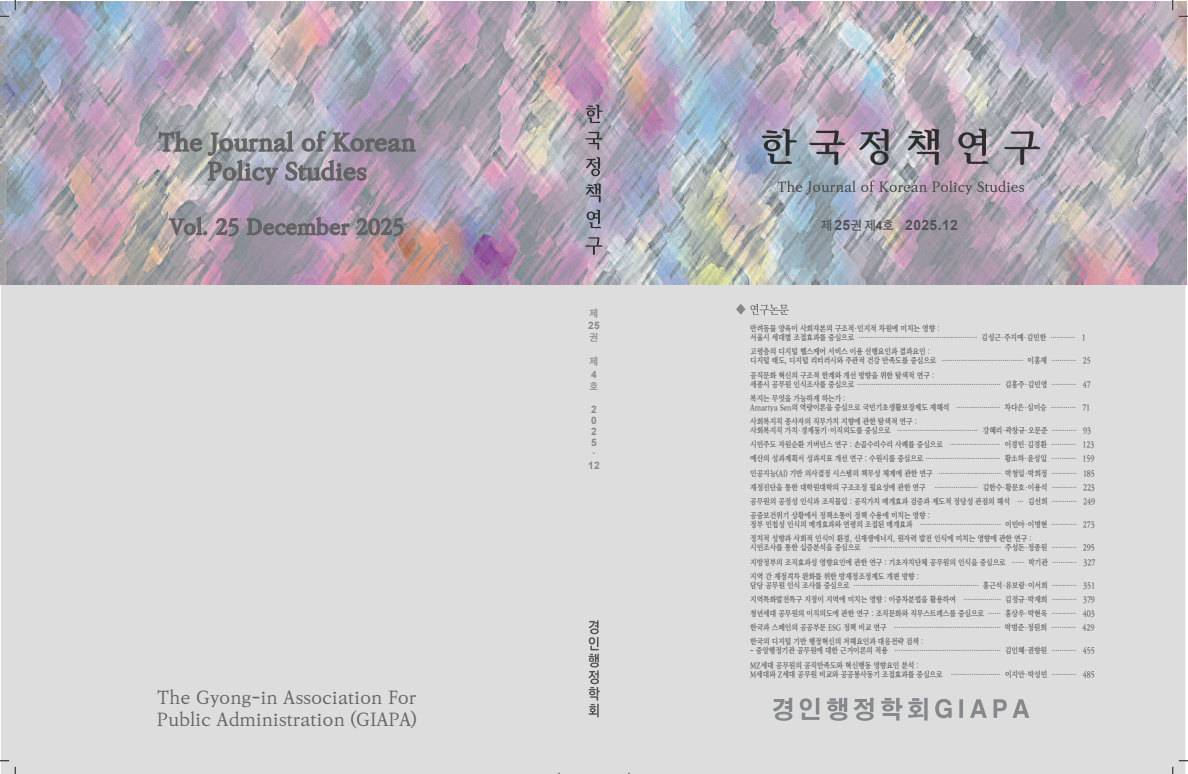
청년세대 공무원의 이직의도에 관한 연구: 조직문화와 직무스트레스를 중심으로
An Empirical Study on the Turnover Intention of Young Generation Public Officials: Focusing on Organizational Culture and Job Stress
- 창간연도
- 2002년 2월
- ISSN
- (Print)1598-7817 , (Online)2713-6744
- 등재사항
- KCI등재(2019.01 ~ 현재)
- 수록권호
- 제25권 4호
- 발행일
- 2025.12
- 수록논문
- 19 articles
- 유형
- 학술저널
- 주제
- 사회과학
- 발행기간
- 2002.02 ~ 2025.12
- 발행주기
- 연 4회(계간)
- 총 권호 수
- 78 volumes
- 총 논문 수
- 771 articles
키워드
초록
최근 청년세대(MZ세대) 공무원이 공직사회를 이탈하는 현상이 나타나고 있다. 2023년 9월, 인사혁신처가 국회에 제출한 자료에 따르면, 2022년 재직기간이 1년이 되지 않은 공무원 중에서 퇴직한 인원은 3,123명인 것으로 나타났다. 이는 2020년에 1,610명이었던 수치에 비해 2배 증가한 수치이다. 최근 계속되는 이러한 현상에 대해 청년세대 공무원들은 조직문화에 대한 회의감이 공직사회를 이탈하는 주된 이유라고 강조했다. 이와 더불어 격무 및 악성민원 등으로부터 비롯되는 직무스트레스 역시 이직을 고민하게 만드는 주된 이유로 꼽힌다. 공무원이 계속해서 공직사회를 이탈하게 되면, 공직사회의 잠재적인 성장을 저해하고 발전적인 미래를 그리기 어렵게 된다. 본 연구는 이러한 문제의식을 기반으로 공직사회를 이탈하는 현상의 원인으로 조직문화와 직무스트레스에 중점을 두어 바라보고자 하였다. 구체적으로는 공직사회의 조직문화와 직무스트레스가 청년세대 공무원이 갖는 이직의도에 미치는 영향관계를 살펴보았다.분석결과, 과업지향 문화는 이직의도에 정(+)의 영향, 혁신지향 문화는 이직의도에 부(-)의 영향, 직무스트레스는 이직의도에 정(+)의 영향을 나타냈으며, 이 중 직무스트레스의 영향력이 가장 큰 것으로 나타났다. 반면 위계지향 문화는 유의한 영향이 확인되지 않았다. 이는 공공조직의 규범·통제 그 자체보다 성과압력·절차적 경직·역할모호성 등 방해 스트레스원이 이탈로 이어지는 직접 경로임을 시사한다. 이러한 결과를 통해 본 연구에서는 조직문화를 개선하고 직무스트레스를 낮추기 위한 다양한 함의점을 제시하고자 하였다.
An increasing number of young (“MZ”) civil servants have been leaving the Korean civil service. According to data the Ministry of Personnel Management submitted to the National Assembly in September 2023, 3,123 civil servants with less than one year of tenure resigned in 2022—roughly double the 1,610 who left in 2020. Young officials commonly attribute this trend to disillusionment with organizational culture, alongside job stress arising from excessive workloads and abusive or vexatious public complaints. Persistent outflows risk undermining the civil service’s capacity for renewal and long-term development.
Motivated by these concerns, this study examines how organizational culture and job stress shape turnover intention among young civil servants. The analysis shows that a task-oriented culture is positively associated with turnover intention, whereas an innovation-oriented culture is negatively associated with it. Job stress exhibits a positive and the strongest association with turnover intention, while a hierarchy-oriented culture shows no statistically significant effect. These patterns suggest that hindrance stressors—such as performance pressure, procedural rigidity, and role ambiguity—constitute a more direct pathway to exit than norms and control per se. Based on these findings, the study outlines implications for redesigning organizational culture and alleviating job stress to strengthen retention of young talent in the civil service.
목차
I. 서론II. 이론적 검토
III. 연구설계
IV. 분석결과
V. 결론
참고문헌 (97)
- 김봉미・한기혜・조용애. (2018). 임상간호사의 위계지향적 간호조직문화와 이직의도 간 사회적 지지 조절효과. 「임상간호연구」, 24(3): 313–323.
- 김영곤・김주경. (2016). 혁신 및 협력행동에 미치는 일중독의 영향요인과 자기효능감의 조절효과에 관한 연구. 「한국인사행정학회보」, 15(3): 163-198.
- 김우성・허은정. (2007). 베이비붐세대, X세대, Y세대 소비자들의 소비관련 가치관과 라이프스타일의 비교. 「소비문화연구」, 10(4): 31-53.
- 김은희・윤혜진. (2022). 빅데이터를 통해 살펴본 코로나19에 따른 세대별 관광 이동행태 변화. 「MICE관광연구」, 22(3): 103-121.
- 김진호. (2023). 해양경찰청 MZ세대가 갖는 조직문화와 직무만족에 대한 인식의 함의. 「사회과학리뷰」, 8(1): 1-19.
- 김진희. (2018). 혁신적 조직문화와 참여가 성과와 이직의도에 미치는 효과. 「문화기술의 융합」, 4(1): 51–56.
- 김화연. (2023). 공공조직 내 조직우선주의가 WLB 정책 접근성에 미치는 영향 연구: 세대(MZ세대 vs 기성세대)에 따른 조절효과를 중심으로. 「정책분석평가학회보」, 33(4): 101-129.
- 대한민국 인사혁신처. (2020, 12월 29일). 2021년 공무원 보수 0.9% 인상, 수당은 동결 [보도자료].
- 대한민국 행정안전부. (2020, 12월 29일). 2021년 지방공무원 보수 0.9% 인상, 수당은 동결 [보도자료].
- 박순애・오현주. (2006). 성과지향적 조직문화와 조직효과성. 「한국행정학보」, 40(4): 225-252.
- 박재흥. (2003). 세대 개념에 관한 연구: 코호트적 시각에서. 「한국사회학」, 37(3): 1-23.
- 박정우. (2019). 공기업 직원들의 조직문화 및 직무스트레스가 이직의도에 미치는 영향: 직급별 차이를 중심으로. 「상업교육연구」, 33(6): 157-173.
- 박현신. (2024). 이직의도에 대한 조직문화와 직무만족의 영향에 관한 연구: 경쟁가치모형을 중심으로. 「한국인사행정학회보」, 23(1): 77–113.
- 박현정. (2024). 「적극행정 행태에 미치는 영향요인: 세대 간 차이를 중심으로」. 석사학위논문, 부산대학교 대학원.
- 배상준・김미애・이지영・임종국・조대연. (2023). 기업조직문화가 구성원의 이직의도에 미치는 영향에 대한 다층분석: 조직 내 무형식학습의 조절효과. 「휴먼웨어연구」, 6(3): 67–90.
- 배성숙. (2024). 혁신지향문화가 신입사원의 직무만족과 이직의도에 미치는 영향: 조직신뢰의 매개효과. 「혁신기업연구」, 9(3): 231–250.
- 백화연. (2022). 「MZ세대의 조직 공정성에 대한 인식이 첫 직장 이직의도에 미치는 영향」. 석사학위논문, 경기대학교.
- 서진우・강종수. (2023). MZ세대 공무원의 후생복지가 조직효과성에 미치는 영향에서 공공봉사동기의 매개효과를 중심으로. 「아시아태평양융합연구교류논문지」, 9(2): 329-339.
- 송은일・이종호. (2017). 시큐리티업무 종사자의 직무스트레스가 조직몰입 및 이직의도에 미치는 영향. 「시큐리티연구」, 50: 265-283.
- 송지준. (2009). 논문작성에 필요한 SPSS/AMOS 통계분석방법. 21세기사.
- 송진희・서인석・윤병섭. (2021). 경기도 보육교사의 이직의도와 직무스트레스의 관계에서 심리적 안녕감의 위치 검증: 확인적 요인분석을 활용한 위치적 특성에 대한 가설적 타당성 검증. 「한국정책연구」, 21(2): 1-25.
- 신지형. (2019). 밀레니얼세대와 Z세대의 미디어 이용. 「KISDI STAT Report」, 19-04: 1-7.
- 연영란. (2014). 간호사의 직무스트레스, 소진, 간호조직문화 및 이직의도. 「한국산학기술학회논문지」, 15(8): 4981-4986.
- 오대혁・김학조・권종욱. (2011). 한국과 중국종업원의 세대간 직무가치관 분석. 「국제통상연구」, 16(1): 103-128.
- 유계숙. (2008). 가족친화적 조직문화가 근로자의 일-가족 조화와 삶의 질에 미치는 영향. 「가정과삶의질연구」, 26(5): 27-37.
- 유승완. (2022). 「대기업 사무직 MZ세대 근로자의 이직의도와 조직공정성, 보상만족, 경력개발지원 및 직무열의의 관계」. 석사학위논문, 서울대학교.
- 윤유진・정건・문국경. (2024). 목표모호성이 이직 의도에 미치는 비선형 효과 분석: 공공봉사동기의 조절효과를 중심으로. 「한국정책연구」, 24(1): 1-26.
- 이병철・전재균. (2023). MZ세대 호텔 종사원이 인식하는 조직문화가 직장 내 일탈행동에 미치는 영향: 직무소진의 매개효과. 「호텔관광연구」, 25(10): 1-14.
- 이요행・방묘진・오세진. (2005). 가족친화적 조직문화가 조직몰입, 직장만족, 이직의도, 그리고 가정만족에 미치는 영향: 직장-가정 갈등의 매개효과를 중심으로. 「한국심리학회지: 산업 및 조직」, 18(3): 639-657.
- 이재은・이연주. (2008). 조직문화 유형이 조직몰입도에 미치는 영향: Kimberly & Quinn의 조직문화 유형을 중심으로. 「한국정책논집」, 8: 60-81.
- 이태희・전민서・정득. (2024). MZ세대 공무원 이직의도의 영향 요인에 대한 구조모형과 직무만족의 매개효과. 「행정논총」, 62(4): 127-164.
- 이현경. (2001). 스포츠센타 직원의 직무스트레스 요인 및 인지평가가 조직 유효성에 미치는 영향. 「한국체육학회지」, 40(3): 465-480.
- 조성용・이지석・박진솔. (2024). 조직문화가 공무원의 이직의도에 미치는 영향: 밀레니얼세대와 Z세대의 조절효과를 중심으로. 「한국행정연구」, 33(1): 69-107.
- 조원섭. (2014). 특급호텔의 조직문화가 이직의도에 미치는 영향. 「Tourism Research」, 39(3): 183-198.
- 조종오. (2024, 2월 28일). 신규임용 공무원의 퇴직 증가 문제: 보수 현실화, 유연한 공직문화 조성 등 범정부 차원의 대응 필요(이슈와 논점 제2203호). 국회입법조사처.
- 조혜진・문국경. (2025). 조직수준의 공공봉사동기가 이직의도에 미치는 영향: 조직공정성의 세 가지 하위차원의 조절효과를 중심으로. 「한국정책연구」, 25(1): 209-238.
- 한국행정연구원. (2023. 8. 1. 접근). https://www.kipa.re.kr
- 행정안전부. (2020). 90년생 공무원이 왔다: 함께 살아가는 두 세대를 위한 공직 사회 소통 바이블. 행정안전부 ‘정부혁신 어벤져스’.
- 홍상우. (2025). 「공무원의 적극행정에 미치는 영향요인에 관한 연구」. 박사학위논문, 성균관대학교 국정전문대학원.
- 홍상우・이대웅. (2023). 조직공정성과 이직의도 간 영향관계에 관한 실증연구: MZ세대 공무원을 중심으로. 「한국행정학보」, 57(3): 1-29.
- 홍은희. (2012). 언론사 조직문화와 재난보도 취재 관행: 기자의 안전을 중심으로. 「사회과학연구」, 19(2): 151-178.
- Ajzen, I. (1991). The theory of planned behavior. Organizational Behavior and Human Decision Processes. 50(2): 179-211.
- Bakker, A. B., & Demerouti, E. (2007). The job demands–resources model: State of the art. Journal of Managerial Psychology. 22(3): 309-328.
- Bozeman, B. (2000). Bureaucracy and Red Tape. Prentice Hall.
- Brewer, G. A., & Walker, R. M. (2013). The Impact of Red Tape on Governmental Performance: An Empirical Analysis. Public Administration Review. 73(6): 861-873.
- Cameron, K. S., & Quinn, R. E. (1999). Diagnosing and changing organizational culture: Based on the competing values framework. Reading, MA: Addison Wesley.
- Cameron, K. S., & Quinn, R. E. (2011). Diagnosing and Changing Organizational Culture: Based on the Competing Values Framework (3rd ed.). San Francisco: Jossey-Bass.
- Cavanaugh, M. A., Boswell, W. R., Roehling, M. V., & Boudreau, J. W. (2000). An empirical examination of self-reported work stress among U.S. managers. Journal of Applied Psychology. 85(1): 65-74.
- Chang, S. J., Koh, S. B., Kang, D., Kim, S. A., Kang, M. G., Lee, C. G., … Park, J. H. (2005). Developing an occupational stress scale for Korean employees. Annals of Occupational and Environmental Medicine. 17(4): 297-317.
- Choi, S., Jang, I., Park, S., & Lee, H. (2014). Effects of organizational culture, self-leadership and empowerment on job satisfaction and turnover intention in general hospital nurses. Journal of Korean Academy of Nursing Administration, 20(2): 206–214.
- Daft, R. L. (2001). Organization theory and design (7th ed.). Cincinnati, OH: South-Western College Publishing.
- Deal, T. E., & Kennedy, A. A. (1983). Corporate Cultures: The Rites and Rituals of Corporate Life. Business Horizons. 26(2): 82-85.
- Demerouti, E., Bakker, A. B., Nachreiner, F., & Schaufeli, W. B. (2001). The job demands–resources model of burnout. Journal of Applied Psychology. 86(3): 499-512.
- Denison, D. R. (1990). Corporate Culture and Organizational Effectiveness. Wiley.
- Denison, D. R., & Mishra, A. K. (1995). Toward a Theory of Organizational Culture and Effectiveness. Organization Science. 6(2): 204-223.
- Edwards, J. R. (1996). An examination of competing versions of the person–environment fit approach to stress. Academy of Management Journal. 39(2): 292-339.
- Gaidhani, S., Arora, L., & Sharma, B. K. (2019). Understanding the Attitude of Generation Z Towards Workplace. International Journal of Management, Technology and Engineering. 9(1): 2804-2812.
- Goodman, E. A., Zammuto, R. F., & Gifford, B. D. (2001). The Competing Values Framework: Understanding the Impact of Organizational Culture on the Quality of Work Life. Organization Development Journal. 19(3): 58.
- Griffeth, R. W., Hom, P. W., & Gaertner, S. (2000). A meta-analysis of antecedents and correlates of employee turnover: Update, moderator tests, and research implications for the next millennium. Journal of Management. 26(3): 463-488.
- Hartnell, C. A., Ou, A. Y., & Kinicki, A. (2011). Organizational Culture and Organizational Effectiveness: A Meta-Analytic Investigation of the Competing Values Framework’s Theoretical Suppositions. Journal of Applied Psychology. 96(4): 677.
- Hobfoll, S. E. (1989). Conservation of resources: A new attempt at conceptualizing stress. American Psychologist. 44(3): 513-524.
- Johnson, J. V., & Hall, E. M. (1988). Job strain, work place social support, and cardiovascular disease: A cross-sectional study of a random sample of the Swedish working population. American Journal of Public Health. 78(10): 1336-1342.
- Jones, G. R. (1983). Transaction Costs, Property Rights, and Organizational Culture: An Exchange Perspective. Administrative Science Quarterly. 454-467.
- Karasek, R. A. (1979). Job demands, job decision latitude, and mental strain: Implications for job redesign. Administrative Science Quarterly. 24(2): 285-308.
- Kristof-Brown, A. L., Zimmerman, R. D., & Johnson, E. C. (2005). Consequences of individuals’ fit at work: A meta-analysis of person–job, person–organization, person–group, and person–supervisor fit. Personnel Psychology. 58(2): 281-342.
- Lazarus, R. S., & Folkman, S. (1984). Stress, appraisal, and coping. New York, NY: Springer.
- Lee, T. W., & Mitchell, T. R. (1994). An alternative approach: The unfolding model of voluntary employee turnover. Academy of Management Review. 19(1): 51-89.
- Lee, T. W., Mitchell, T. R., Holtom, B. C., McDaniel, L. S., & Hill, J. W. (1999). The unfolding model of voluntary turnover: A replication and extension. Academy of Management Journal. 42(4): 450-462.
- LePine, J. A., Podsakoff, N. P., & LePine, M. A. (2005). A meta-analytic test of the challenge stressor–hindrance stressor framework: An explanation for inconsistent relationships among stressors and performance. Academy of Management Journal. 48(5): 764-775.
- March, J. G., & Simon, H. A. (1958). Organizations. New York, NY: Wiley.
- Maslach, C., Schaufeli, W. B., & Leiter, M. P. (2001). Job burnout. Annual Review of Psychology. 52: 397-422.
- Mitchell, T. R., Holtom, B. C., Lee, T. W., Sablynski, C. J., & Erez, M. (2001). Why people stay: Using job embeddedness to predict voluntary turnover. Academy of Management Journal. 44(6): 1102-1121.
- Mobley, W. H. (1977). Intermediate Linkages in the Relationship Between Job Satisfaction and Employee Turnover. Journal of Applied Psychology. 62(2): 237.
- Mobley, W. H. (1982). Employee Turnover: Causes, Consequences, and Control. New York: Addison-Wesley.
- NIOSH. (1999). Stress at Work. National Institute for Occupational Safety and Health.
- Ouchi, W. G. (1980). Markets, Bureaucracies, and Clans. Administrative Science Quarterly. 25(1): 129-141. https://doi.org/10.2307/2392231
- Ouchi, W. G. (1981). Theory Z: How American business can meet the Japanese challenge. Reading, MA: Addison-Wesley.
- Price, J. L. (1977). The Study of Turnover. Ames, IA: Iowa State Press.
- Price, J. L., & Mueller, C. (1986). Absenteeism and Turnover Among Hospital Employees. Greenwich, CT: JAI Press.
- Quinn, R. E., & Rohrbaugh, J. (1983). A spatial model of effectiveness criteria: Toward a competing values approach to organizational analysis. Management Science, 29(3): 363–377.
- Rhoades, L., & Eisenberger, R. (2002). Perceived organizational support: A review of the literature. Journal of Applied Psychology. 87(4): 698-714.
- Robbins, S. P. (2005). Essentials of Organizational Behavior (8th ed.). Upper Saddle River: Prentice Hall.
- Rubenstein, A. L., Eberly, M. B., Lee, T. W., & Mitchell, T. R. (2018). Surveying the forest: A meta-analysis, moderator investigation, and future-oriented discussion of the antecedents of voluntary employee turnover. Personnel Psychology. 71(1): 23-65.
- Schein, E. H. (1990). Organizational Culture. American Psychologist. 45(2): 109.
- Schein, E. H. (2009). The corporate culture survival guide (2nd ed.). San Francisco, CA: Jossey-Bass.
- Schein, E. H. (2010). Organizational culture and leadership (4th ed.). San Francisco, CA: Jossey-Bass.
- Siegrist, J. (1996). Adverse health effects of high-effort/low-reward conditions. Journal of Occupational Health Psychology. 1(1): 27-41.
- Simons, T., & Hinkin, T. (2001). The Effect of Employee Turnover on Hotel Profits: A Test Across Multiple Hotels. Cornell Hotel and Restaurant Administration Quarterly. 42(4): 65-69.
- Strauss, W., & Howe, N. (1991). Generations: The history of America’s future, 1584-2069. New York, NY: William Morrow.
- Tett, R. P., & Meyer, J. P. (1993). Job satisfaction, organizational commitment, turnover intention, and turnover: Path analyses based on meta-analytic findings. Personnel Psychology. 46(2): 259-293.
- Weber, M. (1947). The Theory of Social and Economic Organizations. New York: Free Press.
- Weiss, H. M., & Cropanzano, R. (1996). Affective events theory: A theoretical discussion of the structure, causes and consequences of affective experiences at work. Research in Organizational Behavior. 18: 1-74.
- Zammuto, R. F., & Krakower, J. Y. (1991). Quantitative and Qualitative Studies of Organizational Culture.
- 「연합뉴스」. (2023). ‘떠나는 MZ’ 제주도 퇴직공무원 75% 젊은 세대. 5. 30.
- 「뉴스1」. (2023). 경기도 공무원 퇴사 이유 1위는 의원면직(37.5%)…MZ세대 퇴사 붐 영향? 10. 19.
- 「이데일리」. (2023). “빨리 그만두는 게 답”…퇴직하는 저연차 공무원 ‘급증’. 9. 16.
- 「아시아경제」. (2024). “도저히 정년까지 못 버티겠다”…퇴직하는 MZ공무원들, 이유는? 3. 7.
참고문헌 더보기